LIVING THE BLUES
Author: BRUCE JENKINS Date Posted:15 May 2026
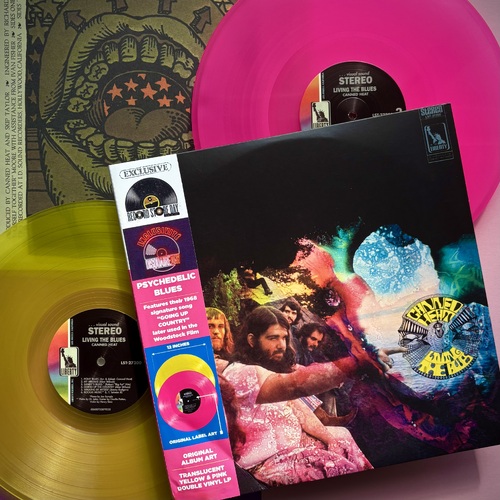
Released in late 1968, Living The Blues confirmed Canned Heat as one of the most significant American blues-rock acts of the counterculture era. The band had already made in-roads with Boogie with Canned Heat earlier that same year, propelled by the hypnotic —and timeless—“On the Road Again.” By the time of this ambitious double LP they were no longer merely blues revivalists; they had evolved into a strange and compelling hybrid: part archivists of pre-war Delta blues, part psychedelic jam band, and part boogie-machine built for late-1960s festival crowds.
Founded by blues enthusiasts Alan "Blind Owl" Wilson and Bob "The Bear" Hite, the band had made an indelible impression at the Monterey Pop Festival in 1967, continuing that success in 1968 at the Newport Pop Festival to an appreciative audience of 80,000. The band then departed for their first European tour, which included television appearances on Top of the Pops in Britain and Beat Club in Germany.
Many consider this Canned Heat line-up—Wilson and Hite plus Henry "Sunflower" Vestine on guitar, Larry "The Mole" Taylor playing bass, and Adolfo "Fido" de la Para behind the drum kit—the quintessential expression not only of the band, but of Sixties American electric blues in general. Part of that is the breadth of their knowledge and respect for this form.
Living The Blues opens, almost religiously, with "Pony Blues", an adaptation of a Charley Patton song. "My Mistake," a Wilson original, is compact and melodic, demonstrating his gift for blues songwriting that didn't merely replicate its sources. "Sandy's Blues," a Bob Hite composition, is the side's centrepiece—a slow-burning, horn-assisted shuffle that unfolds over nearly seven minutes and showcases the interplay between Hite's extrovert delivery and Henry Vestine's coiled lead guitar.
"Going Up the Country," is Wilson's near-note-for-note reworking of Henry Thomas's 1929 "Bull-Doze Blues." It even replicates Thomas's pan-pipe break, here performed by Jim Horn on flute. Disarmingly simple, the catchy tune would become the band's signature. "Boogie Music" features Dr. John on piano, providing a New Orleans flavour pleasingly at odds with the band's West Coast base.
After that refreshing and lively first side, things get experimental. "One Kind Favor" (Blind Lemon Jefferson's "See That My Grave Is Kept Clean") is one of the album's most powerful performances: Vestine's guitar work is rawly expressive, and Hite inhabits the lyric with genuine conviction. Side two then offers "Parthenogenesis," a nine-section, 20-minute suite described as a fusion of blues, raga, sitar music, honky-tonk, guitar distortion and electronic effects, assembled under the experimental direction of Skip Taylor. Its movements range from ambient near-silence to Delta slide; from John Fahey contributing acoustic guitar on the opening "Nebulosity" section to chromatic harmonica passages and psychedelic noise. It is not always coherent, but it is never less than adventurous, positioning Canned Heat as a band offering far more than the repetition of blues standards.
The second record is occupied by the forty-minute “Refried Boogie.” Recorded live, it exemplifies the band’s capacity for locking into extended grooves for mesmerising stretches of time. Critics and listeners remain divided on it: admirers hear a proto-jam-band masterpiece of trance-like rhythm, while detractors find it excessive and self-indulgent. In truth, both assessments are valid. There are exhilarating passages where Vestine and Wilson intertwine brilliantly, while the extended solos and drum sections may test the patience of casual listeners.
Uneven it may be, but Living The Blues was among the first double albums to chart well, peaking at No. 18 on the Billboard Top LPs during a seventeen-week run. The following year "Going Up the Country" became the unofficial anthem of Woodstock, ensuring the album's place in rock mythology.
Footnote: Canned Heat was the slang name for a solid alcohol-based fuel sold in small cans, used as a portable heat source for camping. Desperate—or desperately poor—alcoholics would drink it, often with fatal results.
© Bruce Jenkins—May 2026