
L.A. STORIES
Author: BRUCE JENKINS Date Posted:17 April 2026
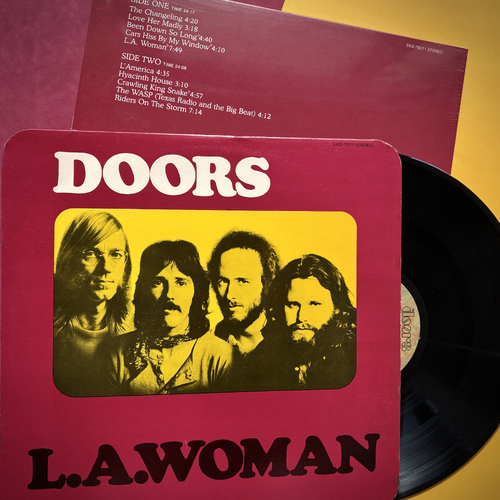
L.A. Woman signifies a culmination and a departure for The Doors. Released on 19 April 1971, the band’s sixth studio album was the last to feature charismatic (and self-destructive) frontman Jim Morrison before his death in July that year.
Morrison had been convicted of indecent exposure following the notorious Miami incident, was contemplating exile, and had physically transformed from the leather-trousered Lizard King into something considerably more dissolute. The band's commercial momentum had stalled, their creative momentum had waned, and Morrison was drowning in alcohol. Against this backdrop, they made arguably the best album of their career.
Falling out with producer Paul Rothschild—who considered the new songs more "cocktail music" than rock—led in a looser, more blues ’n’ boogie feel. L.A. Woman sounds immediate and unvarnished, with a live-in-the-room feel contrasting sharply with the more orchestrated textures of earlier releases. Recording took place in the band’s rehearsal space at The Doors Workshop on Santa Monica Boulevard rather than in a conventional studio. The setup was informal—engineer cum co-producer Bruce Botnick worked from a makeshift control room in the bathroom—while the band played largely live takes.
The album opens with “The Changeling,” a lean, funky declaration of intent. Morrison’s vocal is assertive, almost defiant, over a tight, blues-rock backing. “Love Her Madly” follows, one of the band’s most accessible singles, built around a bright, cyclical guitar figure from Robby Krieger. "Cars Hiss by My Window" is stripped-down and menacing, Krieger's slide guitar snaking around the rhythm.
The album’s title track is also its centrepiece. "L.A. Woman" is a multi-section blues-rock epic capturing both the allure and alienation of Los Angeles. Ray Manzarek’s driving piano and John Densmore’s crisp, jazz-informed drumming underpin Morrison’s stream-of-consciousness vocal, culminating in the “Mr. Mojo Risin’” refrain (an anagram of his name).
Side two opens with “L’America,” originally written for film director Michelangelo Antonioni's Zabriskie Point but rejected—loudly—by the director. It has a darker, atmospheric tone, with shifting dynamics and cryptic lyrics. “Hyacinth House” is restrained, almost pastoral, and offers a glimpse of Morrison’s poetic sensibility.
“Crawling King Snake,” reworks a John Lee Hooker song, reinforcing the album’s deep blues orientation. The band stretches out here, allowing the groove to dictate structure. The album closes with "Riders On The Storm," driven by Ray Manzarek’s Fender Rhodes piano and seasoned with its signature thunder and rain sound effects. These were added by Botnick during mixing. It was apparently Morrison's idea and produced what became one of rock's most recognisably atmospheric closings.
Morrison’s vocals are a key component in the overall impact of the LP. The theatrical baritone of earlier records is replaced by a rougher, more grounded delivery that suits the material. Lyrically, he moves between urban imagery, personal reflection, and mythic flights, often within the same song.
Sonically, the interplay between Krieger’s economical guitar work and Manzarek’s keyboards is strong, while Densmore’s drumming provides both swing and restraint. The addition of veteran session musician Jerry Scheff’s bass gives the album a weight and fluidity that earlier Doors recordings sometimes lacked. (Listen to how he powers "Love Her Madly.")
“Riders On The Storm” and the title track remain staples of classic rock radio, while the album as a whole continues to be seen as a definitive statement of the Doors’ artistic identity. That it also serves as Morrison’s final recorded testament only adds to its resonance fifty-five years on. Having said that, L.A. Woman doesn’t need extra scaffolding to support it. It stands on its own as a direct, honest, blues-soaked piece of work from a band that had everything to prove and, against all odds, proved it.
© Bruce Jenkins—April 2026
