NEXT STOP BERLIN
Author: BRUCE JENKINS Date Posted:29 May 2026
By late 1975 David Bowie was rapidly disintegrating. Having completed shooting Nicolas Roeg's film The Man Who Fell to Earth in Los Angeles he was suffering from severe drug addiction, primarily cocaine, later admitting he recalled almost nothing of the album's production. Bowie's own summary was characteristically mordant: "I know it was recorded in LA because I read it was." Paranoia had taken hold; stories circulated of Egyptian artefacts, black candles, and hallucinations. It is extraordinary that from this all time low came one of the most coherent and compelling albums of his career.
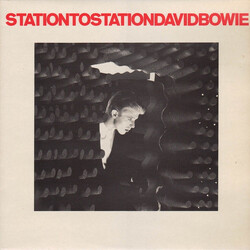
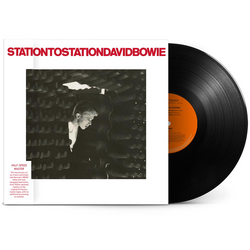
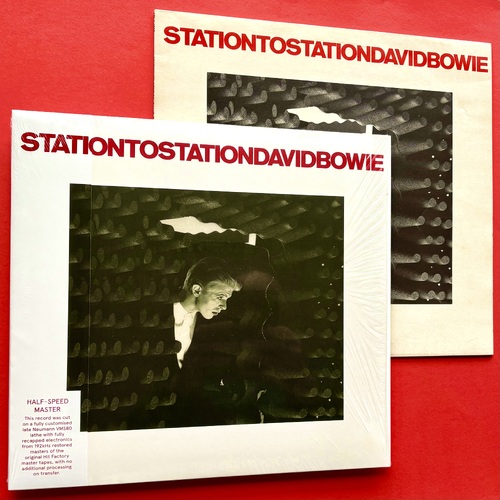
Station to Station was recorded between September and November 1975, co-produced by Bowie and Harry Maslin. The cover art featured a still from The Man Who Fell to Earth. Bowie recruited Maslin—who he had worked with on the Fame session—as co-producer because long-time producer/collaborator Tony Visconti was unavailable. The studio sessions employed a core rhythm section of guitarist Carlos Alomar, bassist George Murray and drummer Dennis Davis; Bowie would use this trio for the rest of the decade. Additional contributions came from guitarist Earl Slick and pianist Roy Brittan.
Bowie later described this period as "singularly the darkest days of my life" yet the music is precise, sculpted, and driven. The recording process saw Alomar and Slick laying down competing guitar parts before Bittan added piano, with vocals recorded last. Producer Maslin often used different microphones to capture Bowie's diverse vocal styles and exceptional range, from the rebel yell of "TVC 15" to the delicate, lovelorn "Wild Is the Wind," and—as was often the case with Bowie—the first take was usually the one that stuck.
It’s not the side effects of the cocaine
I’m thinking that it must be love
Station to Station contains just six tracks across 38 minutes — a compressed, purposeful statement. The title track opens both the album and a new era. At over ten minutes, it is Bowie's longest studio recording — a slow-building locomotive of treated guitar noise that gives way to a hard funk groove, lyrically traversing Aleister Crowley to Gnosticism. It remains one of rock's finest epic tracks.
"Golden Years," the lead single, was the first track recorded and represents the album's closest connection to the straight-up soul of Young Americans. The lustrous production and confident strut belied the chaos surrounding its creator. "Word on a Wing" closes the album's first side. Bowie admitted the song was written out of his cocaine-addled spiritual despair during the filming of The Man Who Fell to Earth. It offers a plaintive cry to heaven after a spiritual crisis and is grand, searching, and unexpectedly moving.
Side two opens with "TVC 15," pulsing with piano-driven energy and carrying a surreal narrative. It is as close to carefree as the record gets. Bittan's rolling piano and Alomar's choppy guitar create a slightly unhinged momentum. "Stay" is the album at its most visceral, exploring relational confusion and the resulting fallout. Slick's guitar work is relentless and the groove is hard, contrasting with the pleading lyrics.
"Wild Is the Wind" closes the album in an utterly different register. A languid cover inspired by Nina Simone's equally remarkable version, it eases Bowie's voice towards its most nakedly expressive, the Thin White Duke momentarily stripped of armour.
Station to Station is regarded as one of Bowie's most significant works. Biographer David Buckley described the Thin White Duke as an "amoral zombie" —a chilling projection of Bowie's actual psychological state rendered into art. Musically, the album was transitional, developing the funk and soul of Young Americans while showcasing a new direction influenced by electronic music and krautrock, particularly Neu! and Can. That dual nature—the body still dancing to American rhythms, the mind already reaching towards Europe—is what gives Station to Station such unusual tension and power.
At the end of the tour supporting the album, Bowie moved to Europe to distance himself from L.A.'s drug culture. The styles explored on Station to Station culminated in his most acclaimed work: the Berlin Trilogy. Station to Station is not quite a Berlin album—it still has the warmth of a recognisable Bowie pop sensibility—but it is unmistakably the bridge. Where Young Americans was an American fantasy and Low would be a European reinvention, Station to Station is the moment of crossing: brilliant, unnerving, and haunted by what came just before and what was just down the tracks.
***
References
- David Buckley [2001] Strange Fascination: David Bowie—The Definitive Story. Virgin, London.
- Nicholas Pegg [2011] The Complete David Bowie. Titan Books, London.
- Hugo Wilcken [2005] Low. Continuum/33 ⅓, New York.
- Robert Dimery (Ed.) [2005] 1001 Albums You Must Hear Before You Die. ABC Books, Sydney.