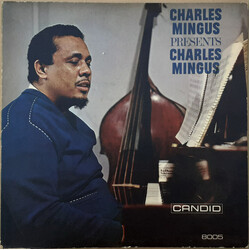
MINGUS PRESENTS
Author: BRUCE JENKINS Date Posted:12 June 2026
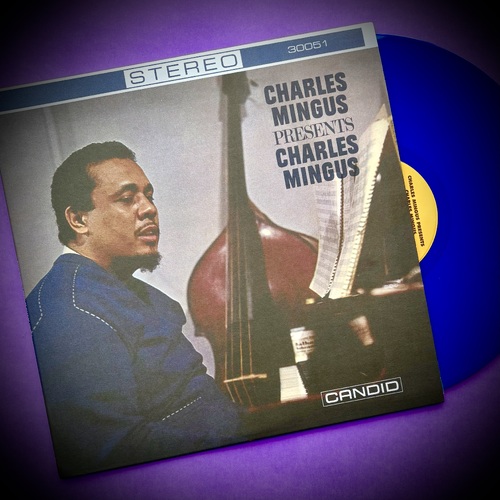
By the time Charles Mingus entered Nola's Penthouse Sound Studios in New York on 20 October 1960 he was already considered one of jazz's most formidable figures: a bassist of superlative technique, a composer of uncommon ambition, and a bandleader whose temperament was as unpredictable as his music was inventive. But the recording that became Charles Mingus Presents Charles Mingus was something different from his major-label work; it was a document of freedom, both artistic and political.
In 1960, jazz critic Nat Hentoff called Mingus to record for the new Candid label, granting him absolute freedom. The quartet — Mingus, Eric Dolphy on reeds, Ted Curson on trumpet, and Dannie Richmond on drums — had been in residence at the Showplace in Greenwich Village for nearly a year prior to entering the studio. The material was road-tested, lived-in, and crackling with accumulated energy. What is more, Dolphy and Curson had recently announced that they were ready to move on from Mingus’ Jazz Workshop, a departure certain to have added a degree of electricity to the session. Nevertheless, Mingus was determined to recreate the atmosphere of those club performances, introducing the songs as if speaking to an audience, even admonishing them not to applaud or rattle their glasses — giving the record the illusion of a live album when in fact it is a studio session.
The album contains four Mingus originals, each demonstrating a different facet of his compositional range. The form is deceptive: these are not merely vehicles for improvisation but carefully structured pieces that move between collective discipline and individual freedom. The album accomplishes what the best of Mingus's work achieves — the perfect tension between jazz played as an ensemble and jazz roaming free.
One track demands particular attention as a compositional statement. On Mingus Ah Um (1959), Columbia had refused to allow vocal passages on what became "Fables of Faubus," forcing Mingus to record it as an instrumental. The Candid date was his first opportunity to record the piece as he intended — here retitled "Original Faubus Fables" and complete with its lyrical diatribe against Arkansas governor Orval Faubus. Mr Faubus was the politician who deployed the National Guard to block black students from entering Little Rock Central High School in 1957. The words were spoken-sung by Mingus and shouted by Dannie Richmond and other band members functioning as a Greek chorus, ferociously condemning racism and racists. It is one of the most direct and unambiguous political statements in jazz composition.
The remaining pieces — "Folk Forms No. 1," "What Love," and the magnificently titled "All The Things You Could Be by Now If Sigmund Freud's Wife Was Your Mother" — map the range of Mingus-as-composer: from blues-rooted forms to near-free improvisation, with the bass not merely supporting but directing.
Since its release in 1961, the standing of Charles Mingus Presents Charles Mingus has only grown. Jazz Journal described the Candid sessions as a summit of Mingus's creativity, with critics placing this among the essential jazz recordings of 1960 — a year that also produced Dave Brubeck’s epochal Time Out. The sense of urgency remains entirely audible. There is little ornamentation, and without a piano filling harmonic space the music feels open and exposed. Every note matters.
If Mingus Ah Um is often recommended as the ideal introduction to Mingus, Charles Mingus Presents Charles Mingus may be the record that reveals his artistic essence most completely: composer, bassist, bandleader, provocateur and visionary, all captured in a single exhilarating session.
*
References
Nat Hentoff (1961) Liner notes to Charles Mingus Presents Charles Mingus [Candid 1961].
Daniel Felsenthal (2026) Charles Mingus "Fables of Faubus" Pitchfork (Accessed 7/06/2026)
Wikipedia: "Charles Mingus Presents Charles Mingus"