CONFIDENT CAT
Author: BRUCE JENKINS Date Posted:23 January 2026
By late 1971 the singer-songwriter trend was no longer developing, it was fully formed. Acoustic instruments, first-person lyrics and emotional candour had become central to mainstream popular music. American artists such as Carole King, James Taylor and Joni Mitchell were redefining how a hit record could sound. Cat Stevens stood slightly apart from this cohort.
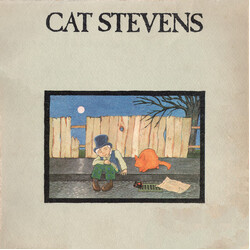
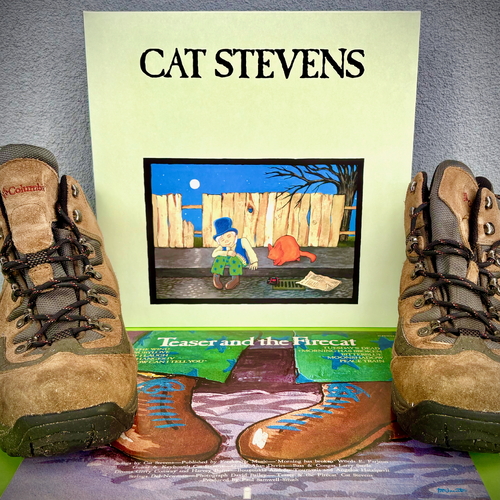
Born in London to a Greek Cypriot father and Swedish mother, the boy known to his parents as Steven Demetre Georgiou lived above the family restaurant on London’s Shaftesbury Avenue, a stones throw from Soho and the theatre district. Where many of his peers leaned toward autobiography or conversational realism, Stevens framed his songs as parables, moral inquiries, and spiritual reflections. Teaser and the Firecat, released in November 1971, captures that distinction and consolidates his position as one of the era’s most widely heard voices.
Crucially, Teaser and the Firecat is not a breakthrough album. That achievement belongs to its predecessor Tea for the Tillerman (1970), whose success established Stevens as both a commercial force and a serious songwriter. Instead, Teaser is a record of consolidation and confidence. There is no sharp stylistic pivot here. Rather, Stevens refines the acoustic-based palette, gentle rhythmic pulse and melodic clarity that had already proven effective. The familiarity of the sound is part of the album’s strength, suggesting an artist comfortable enough with his audience to deepen his style rather than broaden his appeal.
This is most evident in the album’s thematic focus. While Stevens continues to write accessible, emotionally direct songs, he increasingly avoids straight autobiography. Tracks such as “Changes IV” and “Peace Train” are not disclosures so much as moral conversations, framed in ways that invite recognition and resonance. The album’s title and artwork also evoke fable and allegory rather than diary entry. In this respect, Stevens differs markedly from contemporaries like Mitchell or Browne, whose work often foregrounds their own experience. Teaser and the Firecat instead aims for universality, using simple narrative devices to pose questions about responsibility, belief and human connection.
Musically, the album’s success rests on balance. Stevens’ melodies are disarmingly straightforward, often built on folk-derived chord progressions and gentle rhythmic patterns. "Morning has Broken," for example, is based on a hymn, while "Moonshadow" has a nursery rhyme lyric. Cat’s Greek heritage is there in the bouzouki that decorates "Rubylove." Yet beneath that simplicity lies careful craft. The arrangements—produced by Stevens with Paul Samwell-Smith—are restrained but precise, allowing acoustic guitar, piano and subtle percussion to support rather than simply embellish the songs. This economy provides the lyrics with room to breathe and prevents the album’s philosophical weight from becoming heavy-handed. “How Can I Tell You” demonstrates how intimacy and honesty can coexist, while more outward-looking tracks like “Peace Train” show Stevens’ ability to write music that feels communal without sacrificing sincerity. Part of the album’s appeal lies in this careful equilibrium between intimacy, melancholy, and reaching towards a wider social audience. Yet Teaser and the Firecat is neither overtly political nor narrowly personal. Its longevity rests on the way it translates abstract concerns—conflict, spirituality, hopes for peace—into songs that feel approachable rather than didactic. That accessibility has made the album culturally durable even as tastes shifted and the early-1970s singer-songwriter boom has receded into history. The record’s continued presence in popular culture owes less to innovation than to its clarity of purpose: it speaks plainly, inviting reflection without demanding it.
*
References
Crouse, Tim: Teaser And The Firecat. (9 December 1971, accessed 10/01/2026)
Hoskins, Barney: Hotel California—The True-life Adventures of Crosby, Stills, Nash, Young, Mitchell, Taylor, Browne, Ronstadt, Geffen, the Eagles, and their many friends. (Wiley, New Jersey, 2006)
Jake O: The Enduring Legacy of Singer Songwriters of the 70s. (17 September 2025, accessed14/01/2026)
Wikipedia: Teaser And The Firecat (Accessed 17/01/2026)
© Bruce Jenkins—January 2026