NO SURRENDER
Author: Bruce Jenkins Date Posted:11 August 2023
It’s odd to ponder, but Bruce Springsteen’s seventh album—his worldwide commercial breakthrough and biggest seller—is something of an enigma. Sounding for all the world like a big, polished, mid-80s mainstream rock album celebrating all things American, it nevertheless contains some of Springsteen’s most thoughtful, incisive, and emotional songs. How was that unusual amalgam forged?
As most fans know, the gestation of Born In The USA was a difficult one for "The Boss". After his ever-growing fan base responded so positively to The River, a sprawling double album that nevertheless showcased Springsteen’s tighter songwriting chops and emerging commercial sensibility, his plan was to continue with another full band album. But something inside was stirring, churning, unsettling him. As he was writing the multitude of songs from which the final twelve of Born In The USA would be chosen, he took solo time out and recorded 1982’s acoustic Nebraska. He then ripped a page out of his own romantic American Dream playbook and took a long road trip; just him, a mate, a car, and endless highways. He was living the Born To Run dream.
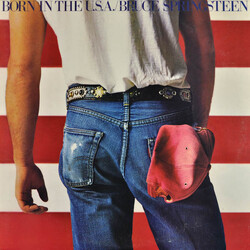
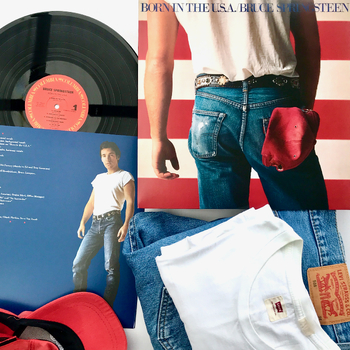
As often happens, into the space crept what was trapped within, and Springsteen experienced a major crisis. He dealt with it in a characteristic two-fisted way: therapy and an intense gym program. It’s been observed that it was this newly buffed Bruce that meshed so well with the now-powerful MTV platform ("Dancing In The Dark") and turned the scraggly New Jersey lad into the matinee idol whose blue-jeaned backside graces Born In The USA’s cover.
Like so much on Born In The USA, the message of that cover image entirely differently under close scrutiny. Some glanced at it and saw a classic piece of American patriotism; working class man faces his flag with potent yet under-stated confidence. Others saw Annie Leibovitz’s photograph as subversive. Is he actually pee-ing on the flag? Shock! Horror!
As with the cover, so with the first song. The title track has a huge percussive intro, chiming like a giant bell, chest-thumping like an army of patriots. A tailor made anthem for US jingoism. Or not. Recall the opening lines.
Born down in a dead man’s town
the first kick I took was when I hit the ground
You end up like a dog that’s been beat too much
Till you spend half your life just covering up
This is a different view of patriotism. One that refuses to buy a faded romantic view of life in America. In his memoir Springsteen wrote, "You don’t hold out and triumph all the time in life. You compromise, you suffer defeat; you slip into life’s gray areas."
So is BITUSA a downer of a record? Not a bit of it! For all its wry observation of dreams faded and hopes dashed, "Glory Days" is a hymn to the survival of the human spirit. "Cover Me" is almost an electro-pop dance hit, bursting with vigour. Sure, there is plenty of studio polish, but that never overrides the life force permeating the songs.
There’s humour, too. Rather dark sometimes—such as the unfortunate under-age romance that lands the protagonist of "Working On The Highway" in a penitentiary-based road repair gang—but humour none-the-less. Steam, too, in the brooding, sensual "I’m On Fire".
Born In The USA is bookended by two of Bruce Springsteen’s strongest and most political songs. The anthemic title track and "My Hometown", his resigned requiem for the America that John Steinbeck wrote about so evocatively late in his life. In between there is friendship ("Bobby Jean"), resilience ("No Surrender") and desperate intimacy ("Cover Me"). The whole of life in a rock album you can sing along to; social criticism and celebration, disaffection and danceability. It’s a classic.
© Bruce Jenkins—August 2023