TIMELESS CHRONICLE
Author: BRUCE JENKINS Date Posted:20 February 2026

John Fogerty (lead vocals, lead guitar), his brother Tom Fogerty (rhythm guitar), Stu Cook (bass), and Doug Clifford (drums) initially played together as The Blue Velvets and later recording as The Golliwogs. After years of graft and stylistic false starts, the group renamed itself Creedence Clearwater Revival (CCR). They polished a roots-focused sound with John Fogerty’s songwriting as the creative core, a process that transformed them into one of the most distinctive American bands of the decade.
John Fogerty drew deeply from American roots traditions—Delta blues, country, gospel, early rock ’n’ roll—stripping away all ornament and excess. The resulting songs feel almost archetypal: tightly constructed, rhythmically assured and immediately accessible. CCR songs rarely waste a second; most arrive at their central idea within moments and leave before the impact fades.
This efficiency is reinforced by the band’s collective discipline. Clifford and Cook were one of late-60s rock’s most reliable rhythm sections, favouring steady, rolling grooves over flashy fills. Tom Fogerty’s rhythm guitar rarely intrudes, instead reinforcing pulse and texture. Over the top sits John Fogerty’s lead guitar—sharp, economical, often riff-based rather than solo-driven. The music’s physicality is key: these songs move, stomp and roll forward, making them endlessly fresh.
Lyrically, Fogerty’s strength lies in his plainspoken storytelling. He avoids abstraction, favouring clear images and direct language. Even when addressing complex themes—class inequality, political corruption, social unease—he frames them in human terms. Songs like “Fortunate Son” and “Who’ll Stop the Rain” resonate because they more like personal testimony than polemics. Fogerty’s voice, raw and insistent, adds urgency without theatricality.
CCR sidestepped both psychedelic meandering and progressive ambition at a time when many peers embraced exploratory forms. Historically, that restraint has worked in their favour. Without extended instrumental excursions, studio trickery or fashionable effects the recordings remain grounded and timeless. CCR songs feel closer to folk standards or early rock classics than to period artefacts, which goes some way to explaining why they continue to thrive on radio, film soundtracks and turntables decades later.
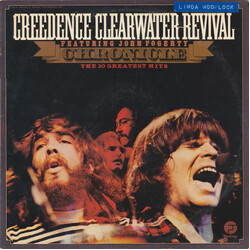
Released in 1976, Chronicle: The 20 Greatest Hits remains an outstanding rock compilation. Across two LPs it covers Creedence’s core recording years (1968–1972), documenting an extraordinary run of singles that span multiple moods and stylistic approaches while maintaining a unified sound. Let’s pick out a few examples of CCR’s craft.
“Proud Mary” exemplifies CCR’s narrative songwriting. Its’ slow-build structure mirrors the lyrical journey from labour to liberation, blending gospel cadence with rock restraint. “Bad Moon Rising” offers a striking contrast: a bright, almost cheerful melody paired with apocalyptic imagery. The tension between sound and meaning gives the song its lasting impact.
On “Green River” we encounter John Fogerty’s gift for myth-making. Musically driven by a churning, mid-tempo riff, the lyric evokes childhood memory and Southern landscape—part real, part imagined—creating a sense of place that feels universal. “Fortunate Son,” perhaps CCR’s most overt political statement, matches its blunt, accusatory lyric with an aggressive, stripped-back arrangement that refuses subtlety; a plain man speaking plainly. “Who’ll Stop the Rain” shifts the tone again, using gentle folk-rock textures to express disillusionment and moral exhaustion. Its’ ambiguity helps the song function both as a Vietnam-era reflection and a timeless expression of uncertainty. Meanwhile, “Up Around the Bend” injects speed and optimism, its Chuck Berry–influenced drive underscoring lyrics about movement and renewal.
The scope of Chronicle lies not just in hit density but in stylistic breadth. Swamp rock, protest songs, roots revival, pop singles and folk reflection coexist comfortably. Few bands managed such consistency across so many charting singles and fewer still sound this coherent when compiled. Combining immediacy and depth, Chronicle doesn’t merely summarise CCR’s career, it demonstrates how varied, focused and durable their songwriting really is. I’d argue that no rock record collection is complete without a generous serving of Creedence Clearwater Revival; Chronicle is the perfect entrée.
© Bruce Jenkins—February 2026