STRUTTIN’ WITH SONNY
Author: Bruce Jenkins Date Posted:26 September 2025
Before pop music exploded worldwide in the mid-1960s, jazz was the thing. It was played on the radio while those seeking a more direct live experience flocked to clubs to hear its sensual saxophones and beguiling beats. With affordable domestic record players and long-playing discs you could even indulge in these auditory pleasures in the comfort of your own lounge room. So many fine musicians recorded excellent that there was never a shortage of new platters to check out at your local department store. While this enthusiasm for America’s most vital contribution to music led to some eternal stars, some highly skilled jazz artists were inevitably overlooked. One didn’t quite get his due was pianist Sonny Clark, whose key album Cool Struttin’ was released on Blue Note in August 1958.
The youngest of eight children, Conrad Yeatis "Sonny" Clark was born in a mining town near Pittsburgh, Pennsylvania. Little is known about his formative years, though it is recorded that his father, a miner, died of lung disease soon after Sonny’s birth. What is known is that he began learning the piano very young (four years old, according to some reports) and moved to the West Coast of the USA at the age of twenty, aiming to establish himself as a jazz musician.
Clark’s early musical associations included tenor player Wardell Gray and highly respected bassist Oscar Pettiford. He then joined clarinetist Buddy DeFranco, with whom he toured the US and Europe. After performing with Dinah Washington across the country, west to east, Clark settled in New York in 1957. He soon became an in-demand session player, supporting a host of the best jazz musicians. Charles Mingus, Sonny Rollins, Kenny Burrell, Grant Green and many others sought out the pianist for his skills as both accompanist and collaborator. If he had not vacated the bandstand well before his time—he was just thirty-one when he died in 1961—it is certain his fluid, inventive piano playing would have ensured lasting fame.
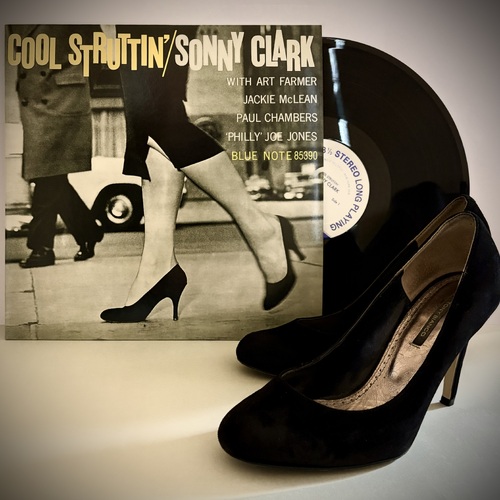
The most highly regarded LP in Clark’s discography as leader is Cool Struttin’. Comprising four lengthy tracks, two per side, it is a stylish yet vibrant hard bop LP that would grace any jazz vinyl collection, not least for the iconic cover. The striking sidewalk-level photograph aside, the sleeve also introduces an outstanding group.
• Sonny Clark – piano
• Jackie McLean – alto saxophone
• Art Farmer – trumpet
• Paul Chambers – bass
• “Philly” Joe Jones – drums
The title track opens side one, a cool but insistent medium-tempo blues walk, with Clark’s left hand laying down a hip, strutting figure. McLean and Farmer contribute tight unison playing, letting you know this is not some thrown-together session—they’re alight from first sight. "Cool Struttin’" exemplifies the hard bop ethos: rooted in the blues, but modern in its phrasing and harmonic colour.
The second track on the LP’s first side is another Clark original. Written in a minor key, it has a haunting, modal-tinged theme that foreshadows some of the darker hard bop moods of the early 1960s. The leader’s long lines are deftly and creatively constructed, superbly underpinned by Chambers and Jones (bass and drums, respectively). McLean demonstrates why he was becoming a major force on alto sax.
On the second side of Cool Struttin’ Jones drums us up a bright, swinging performance of an early Miles Davis tune, "Sippin’ at Bells". Trumpet and sax solos are both vibrant, while the band continues to sound tight integrated and together. "Deep Night" is a song from the late 1920s, given a makeover by Clark and his colleagues. It opens lyrically, almost ballad-like, then shifts into a medium swing. It’s a fine illustration of what hard bop is all about… which is a perfect summary of the entire album. It is no surprise that Cool Struttin’ is widely considered Sonny Clark’s masterpiece.
© Bruce Jenkins—September 2025